
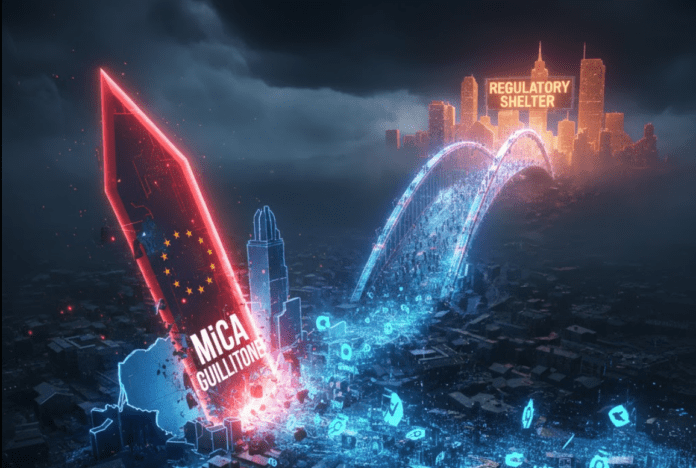
Lithuania has ceased to be the “Wild West” of European crypto. As the Bank of Lithuania drops the MiCA guillotine, once-dominant iGaming rails like utPay and CoinsPaid have vanished into a regulatory blackout. With only a 3% survival rate for registered VASPs, the industry is witnessing a desperate migration to the “Polish Shelter.” Is this a cleanup, or merely a relocation of the shadow economy?
The Great Purge: By the Numbers
Lithuania has transformed from the EU’s most prolific VASP incubator into its most ruthless executioner. For years, the jurisdiction hosted over 850 registered crypto companies, a figure built on a low-barrier, €2,500 capital entry point. Today, that world is dead.
As of January 1, 2026, the Bank of Lithuania’s MiCA transition deadline has passed. The results are staggering:
- Pre-Transition Register: ~850 companies (2022-2024 peak).
- The “CASP” Applications: Only 102 applications were submitted in 2025 (representing just 55 unique companies).
- The Survivors: As of late January 2026, only three (3) CASP licenses have been officially granted.
In this “laboratory situation,” the success rate of the old guard is roughly 3%. The remaining 97%—including high-volume iGaming facilitators like utPay (Utrg UAB) and Dream Finance (CoinsPaid)—have officially “suspended” services. This is not a “voluntary pause”; it is a systemic flushing of entities whose business models—built on the obfuscation of gambling flows—are fundamentally incompatible with MiCA’s transparency mandates.
Regulatory Arbitrage: The “Polish Shelter” Strategy
The “Laboratory” shows that when the guillotine falls, the rats don’t die; they run. Our investigation confirms a massive “Shadow Rail Contagion“ moving toward Poland (read more on Poland’s MiCA transition here).
In the final quarter of 2025, over 22 Lithuanian VASPs relocated their regulatory base to Warsaw. Poland currently serves as a “regulatory shelter” because its MiCA implementation timeline is slightly behind Lithuania’s “cliff-edge” approach. While the Bank of Lithuania demanded a €125,000 capital injection and local substance by the end of 2025, Poland’s transition period allows high-risk entities a few extra months of “legal” existence.
The Question: Who will provide these services in 2026? The Answer: We are already seeing the emergence of multi-layered payment rails. Crypto is no longer the front-facing product; it is being hidden behind Open Banking and Instant Banking interfaces.
The 2026 Forecast: Hide-and-Seek at the EU Level
As the MiCA transition period ends across the remaining EU member states throughout 2026, we predict the following:
- The “Technical Integration” Euphemism: Companies like utPay are already claiming they no longer provide “crypto services” but only “technical payment software.” Expect a surge in unregulated “software providers” that facilitate crypto settlements through offshore partners in the UAE, Canada, or the Comoros.
- Open Banking as a Cloaking Device: The high-risk sector is pivoting. By using licensed AISPs (Account Information Service Providers), processors can trigger instant bank transfers that look like legitimate e-commerce to the bank, while the back-end settle occurs via an offshore VASP.
- The Rise of “Ghost Gateways”: Entities like TheDex (unlicensed and anonymous) will become the primary rails for the “MiCA-Excluded” sector—iGaming, unlicensed trading, and Adult.
Compliance Verdict: A Systemic Displacement
Lithuania has proven that strict regulation works to clean a single jurisdiction, but it does not kill the demand for high-risk rails. 2026 will be the year of the “Global Pass-Through.” We will see EU players depositing via regulated Open Banking widgets, which then route funds to “transitional” Polish VASPs, only to be instantly off-ramped to non-EU “Ghost Gateways.”
The “MiCA Guillotine” has sharpened the industry, but it has also forced the shadow economy to build deeper, more resilient tunnels.
Whistle42 Call to Action
Are you an employee of a Polish VASP seeing a sudden influx of Lithuanian “refugee” accounts? Do you have information on the new “Open Banking-to-Offshore” routing tables?