
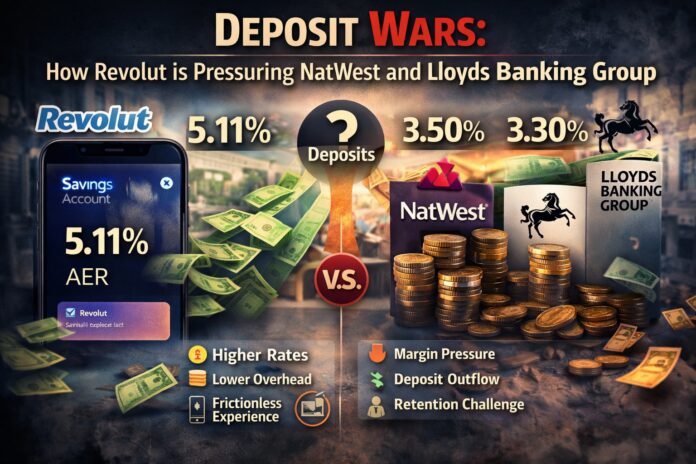
The competitive dynamics in UK retail banking are shifting — quietly, but materially. A new phase of the “deposit war” is emerging, driven not by traditional banks, but by fintech platforms with fundamentally different cost structures and user expectations.
At the center of this shift is Revolut.
The Core Issue: Deposits Are Moving
According to recent reports, Revolut’s expansion into savings products — offering higher interest rates combined with a frictionless digital experience — is beginning to attract deposits away from incumbent banks such as NatWest and Lloyds Banking Group.
For traditional banks, deposits are not merely a funding source. They are the foundation of the lending model.
A sustained outflow has direct implications for:
- Net interest margins
- Liquidity positioning
- Long-term profitability
Why Revolut Has a Structural Advantage
Revolut operates with several structural advantages compared to legacy banks:
- Lower operational overhead
- Faster product iteration cycles
- Digital-native user acquisition and retention
- Ability to pass higher yields directly to customers
These factors allow fintech platforms to compete directly on one of the most sensitive variables in banking: deposit pricing.
The Strategic Pressure on Incumbents
For institutions such as NatWest and Lloyds, the challenge is fundamentally constrained:
- Retain deposits without materially increasing funding costs
- Avoid margin compression while remaining competitive
This creates a structural dilemma:
- If rates are increased, profitability declines
- If rates remain unchanged, deposits migrate
This tension defines the emerging deposit war.
More Than Just Interest Rates
What makes this shift structural rather than cyclical is the change in user behavior.
Customers are increasingly comfortable holding funds outside traditional banks when:
- Onboarding is immediate
- Interfaces are superior
- Yields are visibly higher
Trust, once a defining advantage of traditional banks, is no longer exclusive.
A Broader Implication for Financial Markets
This development extends beyond the UK.
It reflects a broader transformation:
Financial services are being unbundled, and deposits — historically considered “sticky” — are becoming increasingly mobile.
Fintech firms are no longer competing solely on user experience. They are competing directly on balance sheet economics.
Conclusion
The emerging deposit war signals a deeper transition within banking.
If Revolut continues to scale its savings offering, pressure on incumbent institutions will intensify — not only in customer acquisition, but in the underlying economics of their funding model.