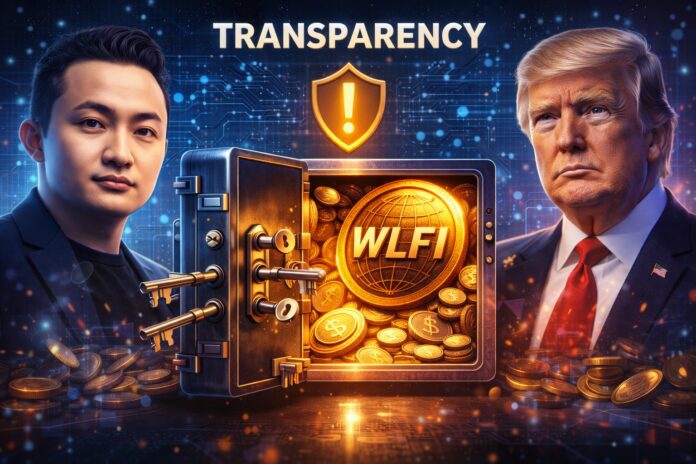
A new controversy is emerging around World Liberty Financial (WLFI), as Justin Sun publicly called for greater transparency — specifically around the project’s multi-signature (multi-sig) wallet structure.
The request highlights a deeper issue in crypto: who actually controls the funds?
The Core Demand: Multi-Sig Transparency
Multi-signature wallets are a standard security mechanism in crypto.
They require multiple parties to approve transactions, reducing the risk of unilateral fund movement.
Justin Sun is now urging WLFI — a project reportedly linked to Donald Trump — to disclose:
- who controls the wallet keys
- how many signatures are required
- how funds are governed
This is not a minor technical detail. It directly defines control, accountability, and risk exposure.
Why This Matters
In institutional finance, custody and control structures are tightly regulated.
In crypto, they often remain opaque.
Without clarity on multi-sig setups, investors face several risks:
- centralized control disguised as decentralization
- potential misuse of treasury funds
- lack of accountability in critical decisions
Transparency around wallet governance is therefore not optional — it is foundational.
WLFI and the Political Layer
The situation is further amplified by the political dimension.
The involvement of Donald Trump — directly or indirectly — introduces additional scrutiny.
Projects operating at the intersection of:
- crypto
- politics
- capital markets
are held to a higher standard, particularly when retail and institutional investors are involved.
A Broader Industry Problem
This is not just about WLFI.
Across the crypto space, many projects still lack clarity in:
- treasury management
- governance structures
- key control mechanisms
Multi-sig transparency is increasingly becoming a benchmark for credibility.
Final Take
Justin Sun’s call is less about criticism and more about setting a standard.
If crypto wants to attract serious capital, it must move beyond narratives and toward verifiable governance structures.
In the end, the question is simple:
Not who owns the tokens — but who controls the keys.