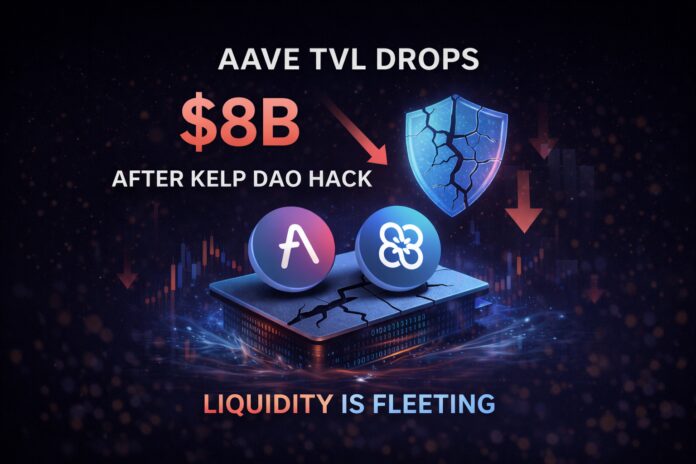
A sharp reminder of DeFi’s reflexive nature: Aave has reportedly seen its total value locked (TVL) drop by $8 billionfollowing the recent exploit linked to Kelp DAO.
The event underscores a critical reality:
Liquidity in DeFi is fast — and it leaves even faster.
The Immediate Impact
TVL is often used as a proxy for trust and platform strength.
But in practice, it is highly reactive.
Following the Kelp DAO incident:
- capital exited rapidly
- positions were unwound
- risk exposure was reduced across protocols
Even though the issue did not originate within Aave itself, the contagion effect was immediate.
Contagion in Composable Finance
DeFi’s strength — composability — is also its weakness.
Protocols are deeply interconnected:
- collateral flows across platforms
- yield strategies stack on top of each other
- risk is shared, not isolated
When one component fails, the system reacts as a whole.
In this case, exposure to Kelp DAO triggered a broader reassessment of risk.
TVL: A Misleading Metric?
The $8B drop raises a broader question:
How reliable is TVL as a measure of stability?
TVL reflects:
- deposited capital
- user confidence (short-term)
- yield attractiveness
But it does not reflect:
- long-term commitment
- risk tolerance under stress
- structural resilience
In volatile conditions, TVL behaves more like hot money than sticky capital.
Risk Management Still Evolving
Incidents like this highlight the current state of DeFi risk frameworks.
While protocols have improved in:
- audits
- collateralization models
- liquidation mechanisms
systemic risk remains difficult to contain.
Particularly when:
- new primitives (like restaking) are introduced
- liquidity layers become more complex
- users chase yield across multiple protocols
Final Take
The $8B outflow from Aave is not just a reaction to a single hack.
It is a reflection of how DeFi behaves under stress.
Capital is mobile. Trust is conditional.
As the ecosystem matures, the focus will shift from:
- maximizing TVL
to:
- managing interconnected risk
Because in DeFi, the real test is not growth —
it’s how the system reacts when something breaks.