
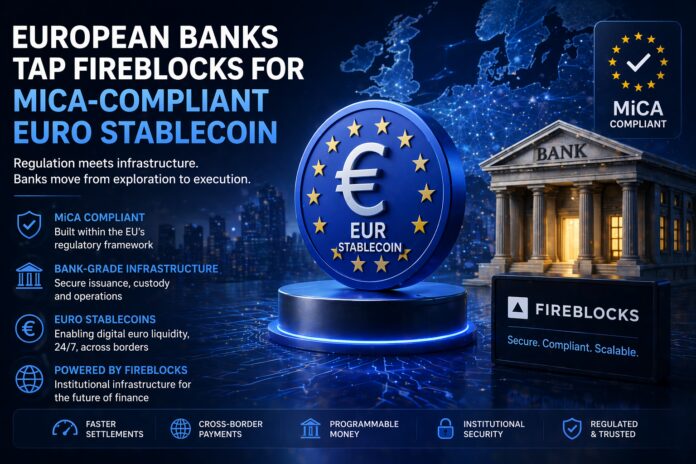
A notable shift is underway in Europe’s financial landscape: several banks are reportedly partnering with Fireblocks to issue MiCA-compliant euro stablecoins.
This marks a critical step in the institutionalization of digital assets — where traditional finance is no longer observing, but actively building.
From Experimentation to Implementation
For years, banks approached crypto cautiously.
Now, with the introduction of MiCA (Markets in Crypto-Assets Regulation), the framework has changed:
- clear regulatory guidelines
- defined compliance requirements
- legal certainty for issuance
This clarity is enabling banks to move from exploration to execution.
Why Fireblocks?
Fireblocks has positioned itself as a key infrastructure provider for institutions entering crypto.
Its offering includes:
- secure custody solutions
- transaction infrastructure
- compliance-ready systems
For banks, this removes a major barrier: building everything in-house.
Instead, they can leverage existing infrastructure while focusing on product and distribution.
The Strategic Importance of Euro Stablecoins
Most stablecoin activity today is dominated by USD-based assets.
Euro-denominated stablecoins represent a strategic gap — and opportunity.
For European banks, this enables:
- digital euro liquidity rails
- faster cross-border settlement
- integration with existing banking systems
In effect, stablecoins become programmable bank deposits.
MiCA as a Catalyst
MiCA is emerging as one of the most important regulatory frameworks globally.
It introduces:
- licensing requirements for issuers
- reserve and transparency obligations
- consumer protection standards
This reduces uncertainty — but also raises the bar.
Only players with:
- strong compliance structures
- institutional-grade infrastructure
- sufficient capital
will be able to compete.
A Convergence of TradFi and Crypto
The collaboration between banks and providers like Fireblocks signals a broader convergence.
We are moving toward a hybrid model where:
- traditional institutions issue digital assets
- crypto infrastructure powers them
- regulation defines the boundaries
This is not disruption — it is integration.
Final Take
The move toward MiCA-compliant euro stablecoins is more than a regional development.
It reflects a global trend:
Digital assets are becoming part of the regulated financial system.
For banks, the question is no longer whether to enter crypto —
but how fast they can build within the new rules.