
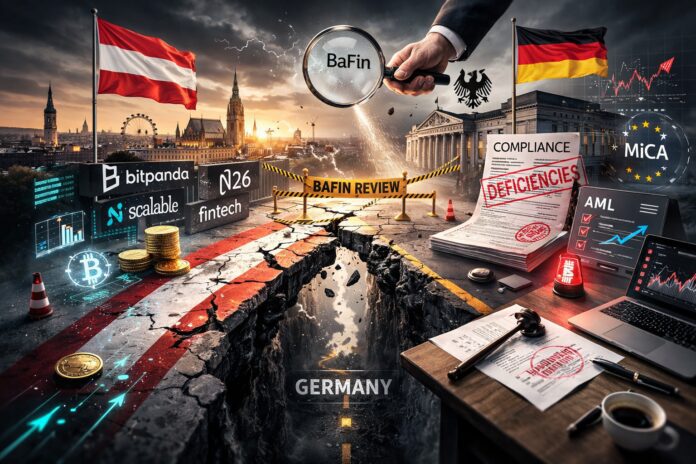
In recent months, a pattern has caught attention in the DACH financial scene: Austrian fintech and crypto players repeatedly finding themselves under the scrutiny of Germany’s financial watchdog, the Bundesanstalt für Finanzdienstleistungsaufsicht (BaFin).
From structural findings at Bitpanda’s German entity to long-standing supervisory pressure on Berlin-based N26, the question arises: Is BaFin “shooting” at Austrian companies — or is something deeper happening?
The Perception: Targeting Austrian Innovators
Austria has positioned itself as a fintech-friendly environment. Vienna, in particular, became a base for crypto platforms scaling into the broader EU market. When these companies expand into Germany — Europe’s largest retail finance market — they enter a fundamentally different supervisory culture.
The result? Headlines about:
- Severe deficiencies
- Special audits
- Growth restrictions
- Governance warnings
To some observers, this feels like regulatory hostility. But the reality is more structural than political.
Germany’s Post-Wirecard Reflex
Since the collapse of Wirecard, BaFin has undergone a profound transformation. The authority shifted from being criticized as too passive to being visibly interventionist.
Three major consequences followed:
- Lower tolerance for compliance gaps.
- Stricter AML (Anti-Money Laundering) enforcement.
- Aggressive scrutiny of cross-border structures.
Any fintech operating in Germany — domestic or foreign — is now assessed under this tightened regime. Austrian firms expanding into Germany simply encounter that environment head-on.
The Structural Tension
The friction is not about nationality. It is about speed versus supervision. Many high-growth fintechs scaled rapidly across the EU using passporting freedoms. Compliance frameworks often evolved after customer acquisition.
Infrastructure first. Growth second.
If internal controls, risk management systems, or AML structures lag behind, intervention follows — publicly and decisively.
Why Austrian Firms Feel the Pressure More
There are three practical reasons Austrian players are more visible in this dynamic:
- Primary Market: Germany is their primary expansion market.
- High-Risk Verticals: They operate in crypto, digital assets, and online brokerage.
- Jurisdiction Complexity: They often run multi-entity structures across jurisdictions.
Not Austria vs. Germany — But Fintech vs. Maturity
What we are witnessing is not a geopolitical clash. It is a maturity test. The era of regulatory arbitrage within the EU is narrowing. With MiCA implementation and strengthened AML regimes, supervisory standards are converging upward.
For Austrian fintechs — as for German ones — the message is clear:
- Governance must match growth.
- Internal controls must scale with user numbers.
- Cross-border models require harmonized compliance, not patchwork solutions.
Conclusion
BaFin is not targeting Austria. It is signaling something broader: The DACH fintech ecosystem is moving from expansion mode to institutional phase.
Institutions operate under different rules than startups. The question is no longer whether innovation can move fast. The question is whether it can move fast — and stay structurally compliant at scale.