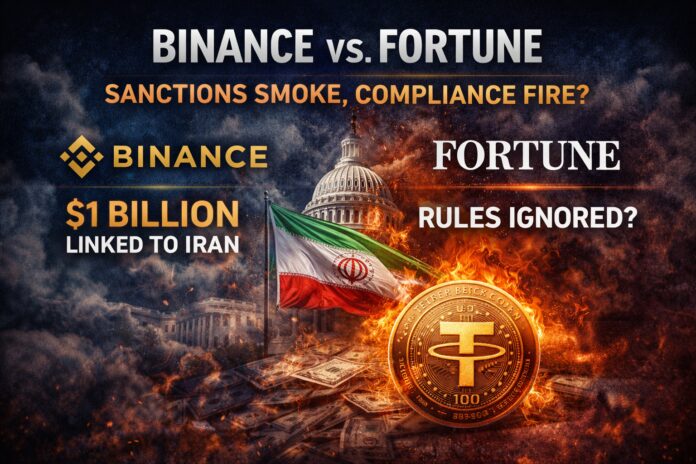
When the world’s largest crypto exchange says “nothing to see here,” markets tend to listen. But when investigative journalists allege that over $1 billion tied to Iranian entities moved through the system, regulators lean forward.
This week, Binance found itself back in the spotlight after a Fortune report claimed that more than $1 billion in transactions linked to Iranian actors flowed through the exchange between March 2024 and August 2025 — largely via USDT on the Tron blockchain, a corridor long criticized by compliance experts as high-risk and opaque.
The most explosive element of the report: internal compliance investigators allegedly flagged the activity — and were reportedly pushed out.
Binance’s Position: “Completely False”
Binance responded swiftly, calling the report materially inaccurate, misleading, and fundamentally wrong.
According to the exchange:
- No sanctions violations were identified.
- No investigators were dismissed for raising compliance concerns.
- Internal reviews, including assessments by external counsel, cleared the matter.
- Compliance controls remain robust and continuously improving.
It is a firm denial — designed to stabilize confidence quickly.
But in crypto, historical context matters.
Why This Story Lands Differently
Binance continues to operate under the shadow of its $4.3 billion U.S. settlement in 2023 — one of the largest enforcement actions in crypto history. That settlement addressed anti-money-laundering and sanctions compliance failures and brought heightened regulatory oversight.
So when new allegations involve potential sanctions-linked flows connected to Iran, even if disputed, the story does not land in isolation.
It lands in an environment already conditioned for scrutiny.
Systemic Weakness — or Narrative Collision?
Two competing narratives are now emerging:
Narrative One
A restructured Binance, under evolving leadership, committed to strengthening compliance infrastructure and regulatory cooperation.
Narrative Two
A global exchange built on aggressive growth, where compliance may struggle to keep pace with transaction velocity and internal concerns may not always translate into external action.
The truth may lie somewhere in between. Or it may not.
What heightens sensitivity is the reference to USDT on Tron — a blockchain ecosystem frequently highlighted by regulators for its liquidity, speed, and comparatively lower friction compared to traditional financial rails.
Even absent confirmed violations, the optics are significant.
Markets React to Ambiguity
There has been no immediate systemic fallout — no exchange run, no structural collapse. But infrastructure confidence in crypto rarely deteriorates overnight. It erodes incrementally.
For regulators across the United States, Europe, and Asia, the episode reinforces a broader reality:
Crypto exchanges are not merely trading venues. They are geopolitical financial gateways.
When sanctions regimes, Iran, and billion-dollar transaction volumes intersect in headlines, the matter shifts beyond industry gossip. It enters national security territory.
Bottom Line
One of two scenarios is correct:
- Binance is facing allegations built on incomplete or misinterpreted information.
- There remain unresolved compliance tensions inside the world’s largest crypto exchange.
In crypto markets, perception influences capital almost as much as confirmed facts.
And at the moment, perception is once again raising difficult questions.