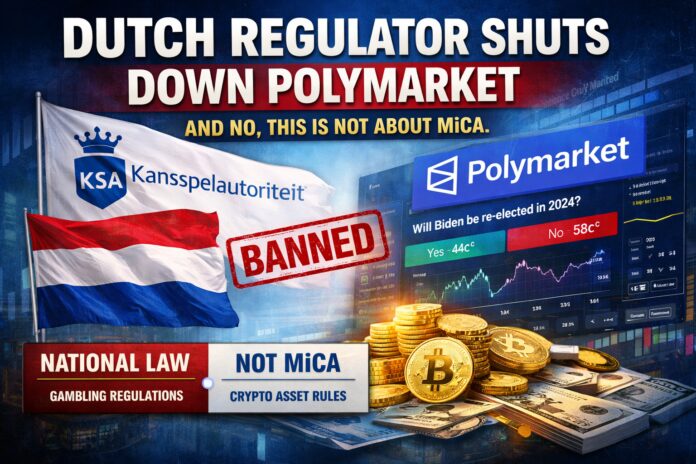
The Dutch gambling regulator, the Kansspelautoriteit (KSA), has ordered Polymarket to cease its operations in the Netherlands. The decision has triggered discussions across crypto circles, with some asking whether the action is linked to the EU’s Markets in Crypto-Assets Regulation (MiCA).
The short answer: it is not.
This case is not about MiCA. It is about national gambling law.
Why the Dutch Regulator Intervened
Polymarket allows users to speculate on the outcomes of real-world events. Users place funds on specific outcomes and receive payouts if their prediction proves correct. While the platform presents itself as a decentralised prediction market, the Dutch regulator views the activity differently.
From the regulator’s perspective, the structure qualifies as gambling under Dutch law because:
- Users stake money
- The outcome depends on uncertain future events
- There is a financial gain or loss involved
Under the Dutch Remote Gambling Act, any operator offering gambling services to Dutch residents must hold a local licence. According to the KSA, Polymarket does not hold such a licence but remained accessible to users in the Netherlands.
That accessibility is sufficient to trigger enforcement.
What This Has to Do With MiCA
Very little.
MiCA regulates crypto-assets, token issuers, and crypto-asset service providers within the European Union. It focuses on areas such as:
- Stablecoin issuance
- Crypto service provider licensing
- Transparency and disclosure requirements
- Market abuse rules
MiCA does not regulate gambling.
If a product qualifies as gambling under national law, MiCA does not override that classification. Sector-specific regulation continues to apply independently.
The Key Legal Question
The central issue is not whether the platform uses blockchain. The key issue is how regulators classify the underlying economic activity.
Authorities assess substance over structure. If users are effectively placing bets on event outcomes with the possibility of financial return, regulators may treat the platform as a gambling operator, regardless of decentralisation claims or token-based settlement mechanisms.
Technology does not neutralise legal classification.
The Broader Regulatory Trend
This action reflects a wider European pattern:
- Regulators are becoming more assertive
- Cross-border digital access is no longer tolerated without local compliance
- Grey zone models are facing increasing scrutiny
Prediction markets operate at the intersection of financial speculation and gambling. That hybrid nature makes them particularly vulnerable to enforcement in jurisdictions with strict gambling frameworks.
Strategic Implications for Web3 Operators
For crypto-native projects, this case reinforces a recurring theme: MiCA is not a universal regulatory shield.
Even fully MiCA-compliant crypto businesses may still fall under:
- Gambling law
- Securities law
- Payment services regulation
- Consumer protection rules
If a product can be accessed in a jurisdiction, that jurisdiction’s laws may apply.
Conclusion
The Dutch order against Polymarket is not a MiCA enforcement action. It is a gambling law enforcement measure.
The broader lesson for Web3 is straightforward: regulatory exposure is determined by economic function, not technical architecture. Decentralisation does not remove the need for jurisdiction-specific compliance.
As EU regulatory oversight tightens in parallel with MiCA implementation, platforms operating in legally sensitive categories will need to decide whether to adapt to licensing frameworks — or accept increasing enforcement risk.