While U.S. crypto heavyweights report massive Q4 losses amid collapsing token prices, Europe faces a more structural crisis. The MiCA transition is turning Lithuania into a regulatory stress laboratory — and early signals suggest a wave of “quiet” and “regulatory” bankruptcies may reshape the EU crypto landscape by 2026.
Key Findings
- Major U.S. crypto firms reported significant Q4 2025 losses amid depressed market conditions and falling trading volumes.
- EU crypto companies face dual pressure: market contraction and MiCA-driven regulatory filtration.
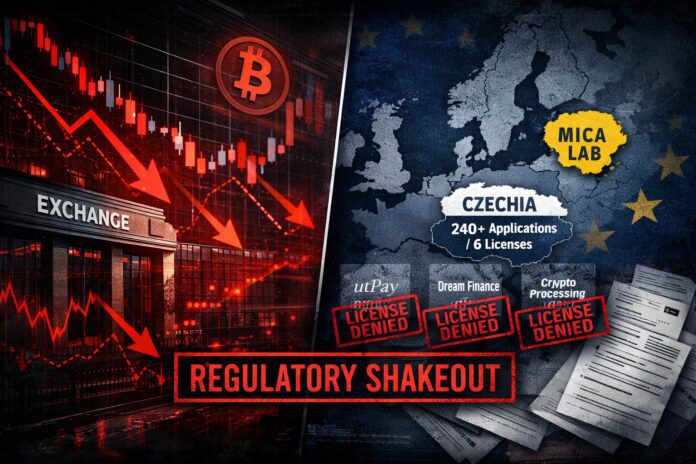
- Lithuania’s grandfathering period ended December 31, 2025, triggering exits and liquidations (e.g., utPay, Dream Finance dba CoinsPaid and CryptoProcessing).
- Czechia reportedly received over 240 MiCA applications but granted only a handful of licenses (≈6), highlighting regulatory bottlenecks.
- Regulatory arbitrage (e.g., migration from Lithuania to Poland) remains possible but temporary.
- By end-2026, passporting and transitional windows will close across the EU.
- A significant “regulatory shakeout” appears inevitable.
- Merchants and investors face elevated counterparty and operational risk.
Market Context: Crypto Winter 2.0
Q4 2025 marked another contraction phase for the crypto sector. Declining token prices, reduced retail participation, and tightening liquidity impacted trading volumes globally. U.S.-listed players such as Coinbase, Strategy (formerly MicroStrategy), and Galaxy Digital reported substantial losses driven by:
- Lower spot and derivatives volumes
- Impairments on digital asset holdings
- Reduced institutional activity
- Shrinking spreads and margins
However, in the U.S., the downturn remains primarily market-driven.
In the EU, the situation is fundamentally different.
MiCA: Structural Transformation, Not Just a Bear Market
The EU crypto sector is not merely in a cyclical downturn — it is undergoing regulatory reconstruction.
MiCA (Markets in Crypto-Assets Regulation) introduces:
- Licensing requirements for CASPs
- Strict governance, capital, and compliance obligations
- Enhanced AML/KYC enforcement
- Passporting under uniform EU authorization
For years, Lithuania functioned as a low-barrier crypto hub. That era ended on December 31, 2025, when its grandfathering regime expired.
The result:
- Numerous VASPs disappeared from public registers
- Some entered liquidation
- Others ceased operations quietly
- Several rebranded or attempted jurisdictional migration
Lithuania now serves as a live test case of MiCA market filtration.
Czechia: The Licensing Bottleneck
Reports indicate that more than 240 MiCA applications have been submitted in Czechia, yet only a very small number (≈6) have reportedly received authorization so far.
This suggests:
- High rejection rates likely ahead
- Slow supervisory processing
- Significant compliance gaps among applicants
If replicated across other member states, the outcome is clear:
Most currently registered crypto firms will not survive the authorization process.
The Coming Wave: Quiet & Regulatory Bankruptcies
Two patterns are emerging:
1. Quiet Bankruptcies
Companies cease operations without formal insolvency — websites disappear, services halt, customer support vanishes.
2. Regulatory Bankruptcies
Firms unable to obtain MiCA authorization lose legal ability to operate and effectively collapse, even if not economically insolvent.
Entities such as utPay and Dream Finance illustrate how regulatory pressure alone can force market exit.
Regulatory Arbitrage: A Temporary Escape
Some operators are relocating from Lithuania to jurisdictions like Poland, where transitional frameworks remain more permissive.
However:
- Poland must implement full MiCA compliance.
- EU-wide harmonization closes arbitrage pathways.
- By end-2026, most transitional loopholes will disappear.
This suggests that current migrations represent delay strategies, not sustainable business solutions.
Will There Be a Massive Shakeout?
The probability is high.
The EU crypto ecosystem currently contains hundreds of small and mid-sized VASPs operating with thin capitalization and limited compliance infrastructure.
Under MiCA:
- Capital requirements increase
- Governance standards tighten
- AML scrutiny intensifies
- Regulatory reporting expands
In a declining market environment, revenue contraction collides with compliance cost inflation.
This combination historically produces consolidation, insolvency, or forced exits.
The EU crypto market of 2027 may look radically different — smaller, more institutionalized, and dominated by fewer, well-capitalized players.
Conclusion: Europe’s Crypto Darwinism Phase
The EU is entering a Darwinian restructuring phase.
Unlike the U.S., where market forces dominate, Europe combines market downturn with regulatory filtration.
Lithuania demonstrates what happens when the grandfathering window closes.
Czechia shows how few firms may ultimately qualify.
By end-2026, regulatory arbitrage corridors will narrow dramatically.
A substantial number of current EU crypto operators are unlikely to survive.
The question is not whether there will be bankruptcies —
but how many will occur silently.
Call for Information
If you have insider information about MiCA licensing failures, quiet liquidations, regulatory relocations, or crypto companies struggling to survive the transition, we encourage you to share it confidentially via Whistle42.com. Your information helps protect merchants, investors, and market integrity.