
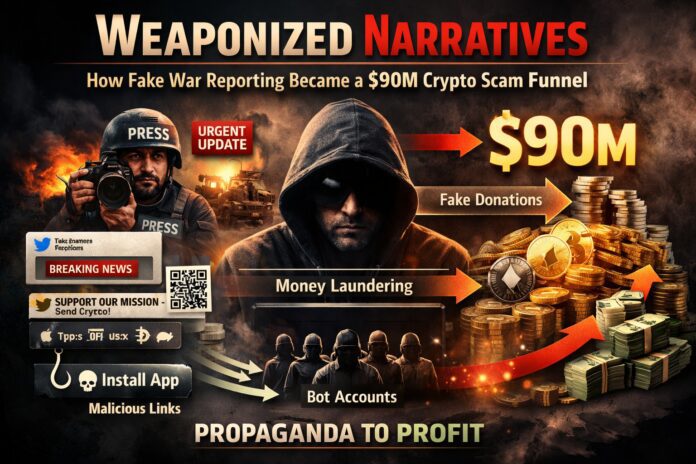
The latest investigation by ZachXBT exposes a development that is less about technical sophistication and more about strategic manipulation: the industrialization of misinformation as a financial extraction tool.
At its core, this is not a new type of crypto scam. What has evolved is the delivery mechanism.
Misinformation as Infrastructure
The network operates primarily on X, where accounts present themselves as independent war correspondents or on-the-ground journalists. Their content is engineered for emotional impact: conflict footage, breaking updates, and highly charged narratives — often AI-generated, recycled, or stripped of context.
The objective is not immediate monetization. It is trust accumulation at scale.
Once credibility is established, monetization follows structured pathways:
- Fake humanitarian appeals: Wallet addresses presented as aid channels, but controlled by the operators.
- Malicious “news” applications: Users are encouraged to install apps that request wallet connections, enabling asset drainage.
- Algorithmic amplification: Bot networks simulate engagement, creating artificial legitimacy and increasing visibility.
This is a structured funnel:
Awareness → Trust → Action → Extraction
Following the Money: The $90 Million Network
The investigation links these activities to a broader laundering operation associated with an individual known as “John” or “Lick,” identified as John Daghita.
The scale is significant: over $90 million in illicit flows.
The laundering methodology reflects established on-chain obfuscation techniques:
- Transaction fragmentation: Funds are split into micro-transactions to reduce traceability.
- Cross-chain bridging: Assets are moved across ecosystems such as Ethereum and TRON to complicate tracking.
- Exit layers: Instant exchanges and opaque stablecoin rails are used to convert crypto into fiat or physical assets.
A particularly concerning element is the reported link between some of these flows and wallets previously associated with the U.S. Marshals Service. Whether this indicates direct compromise or secondary exposure remains unclear, but it highlights a critical point:
Even seized or “secured” digital assets are not immune within insufficiently controlled operational environments.
The Real Vulnerability: Human Behavior
Technically, none of this is groundbreaking.
There is no novel exploit, no zero-day vulnerability, and no protocol failure.
The attack surface is behavioral:
- Urgency driven by crisis narratives
- Emotional decision-making under uncertainty
- Misplaced trust in perceived authority figures
These operations resemble psychological campaigns as much as financial crimes.
Implications for DeFi and “Green Web3”
This case extends beyond direct financial loss. It exposes a structural credibility challenge across the decentralized ecosystem.
As the industry moves toward:
- On-chain carbon credits
- ESG-linked tokens
- Tokenized real-world assets
…the underlying assumption is trust in digital infrastructure and verification mechanisms.
That assumption remains fragile.
If users cannot distinguish between legitimate and fraudulent donation flows during humanitarian crises, adoption barriers for more complex financial instruments increase significantly.
The implication is structural:
Verification must become native, not optional.
Projects operating in areas such as climate finance or ESG-linked tokenization will require:
- Transparent wallet attribution
- Verifiable identity layers
- Real-time transaction monitoring
- Public audit trails accessible to non-technical users
In effect, the forensic standards applied by investigators like ZachXBT must be embedded directly into user-facing infrastructure.
Conclusion
What this investigation reveals is not just another scam network. It is a blueprint.
A model where narrative manipulation replaces technical exploitation, and where social platforms function as distribution infrastructure for financial crime.
For the crypto industry, the takeaway is clear:
Security is no longer only about code. It is about context, perception, and verification.
Without addressing this layer, the gap between innovation and trust will continue to widen.